ESSLLI 2026 course · Prague · 10–14 August 2026

Computational perspectives on the classical decision problema vade mecum

Bartosz Bednarczyk TU Wien & University of Wrocław
Ian Pratt-Hartmann University of Manchester & University of Opole
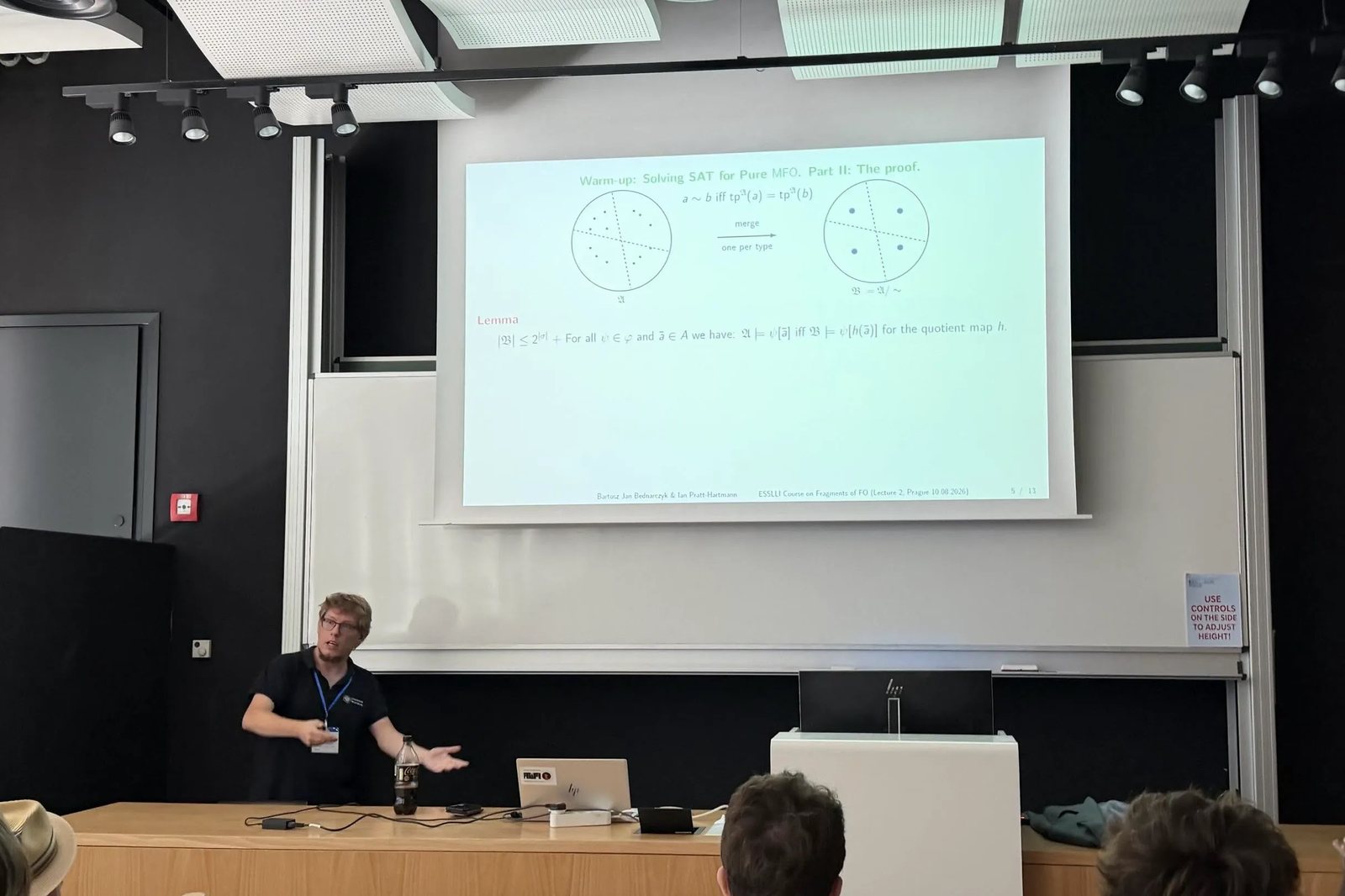
Bartosz Bednarczyk lecturing on the monadic fragment at ESSLLI 2026
Bart, Lecture 2
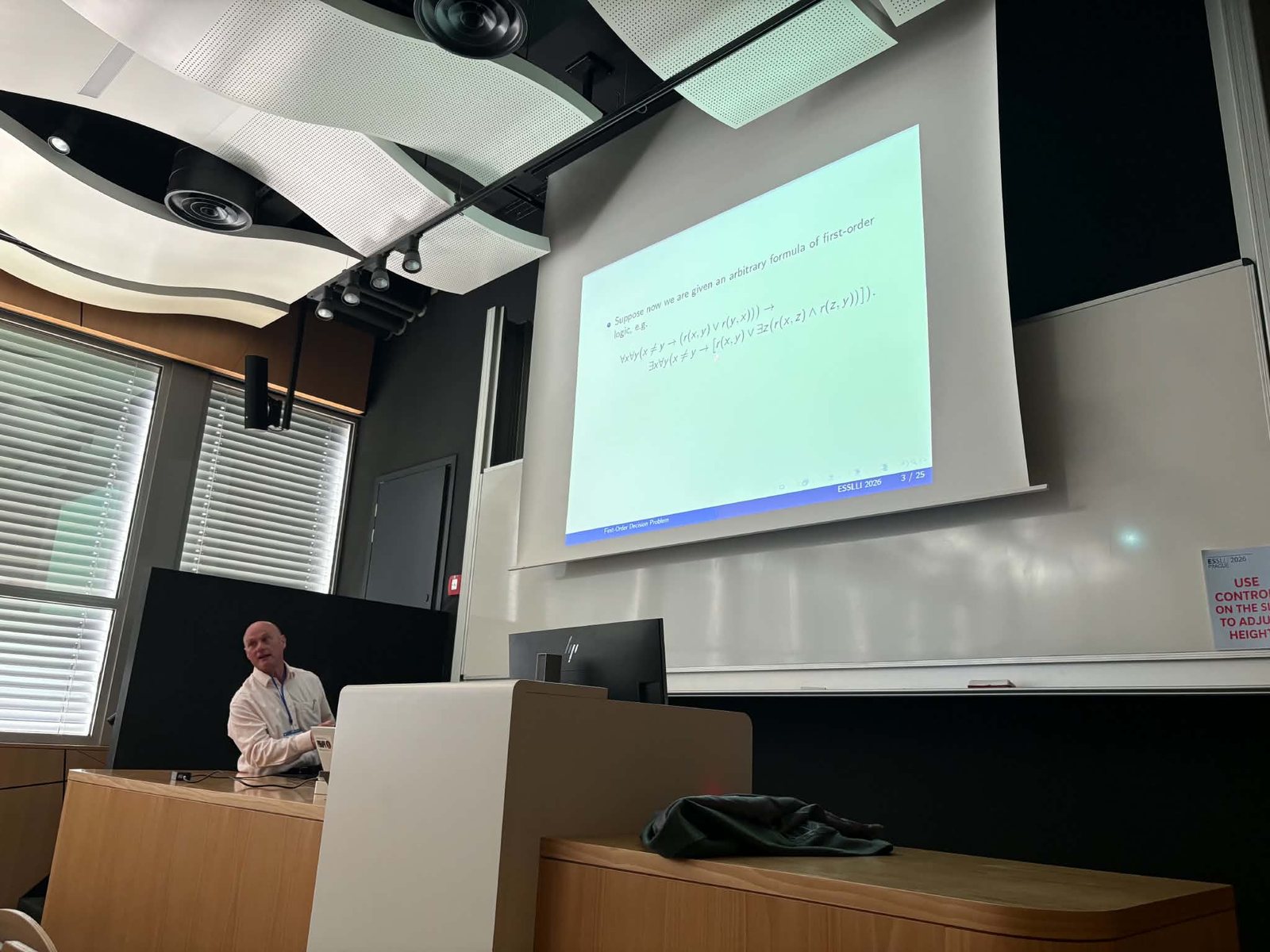
Ian Pratt-Hartmann lecturing on the first-order decision problem at ESSLLI 2026
Ian, Lecture 1

Abstract

The classical decision problem for first-order logic asks whether a given sentence of first-order logic is satisfiable, i.e. whether it is true in some structure. While this problem is undecidable for first-order logic as a whole, its restrictions to certain fragments of first-order logic are known to admit of an effective solution. One of the central goals of research in mathematical logic in recent decades has been to determine the decidability and complexity of this problem for different fragments of first-order logic.

This course surveys major decidable fragments of first-order logic, including the two-variable, guarded, and fluted fragments, along with their extensions with counting quantifiers. These logics present different challenges, often requiring specialized techniques such as reduction to integer programming, small model constructions, tree decompositions, variable elimination, and reduction to tiling problems. We provide a comprehensive treatment of these techniques and briefly survey some open problems.

Programme and slides

Ian Pratt-Hartmann Bartosz Bednarczyk

Day 1 Monday, 10 August 2026

Lecture 1: Introduction

Ian Pratt-Hartmann

The classical decision problem for first-order logic and a map of the course.

Slides

Lecture 2: The monadic fragment

Bartosz Bednarczyk

Monadic first-order logic with equality and constants: one-types, small models and NExpTime upper bounds.

Slides

Day 2 Tuesday, 11 August 2026

Lecture 3: The two-variable fragment

Ian Pratt-Hartmann

FO², the fragment of first-order logic with at most two variables.

Slides

Lecture 4: The guarded two-variable fragment

Bartosz Bednarczyk

Guards turn global search into local search: satisfiability and finite satisfiability of GF² are ExpTime-complete.

Slides

Day 3 Wednesday, 12 August 2026

Lecture 5: The Gödel fragment

Ian Pratt-Hartmann

Prenex formulas and the Gödel fragment.

Slides

Lecture 6: Counting and the linear-equation method

Bartosz Bednarczyk

One-variable logic with counting quantifiers: satisfiability of C¹ is NP-complete via integer programming.

Slides

Day 4 Thursday, 13 August 2026

Lecture 7: The two-variable fragment with counting

Ian Pratt-Hartmann

C², two variables with counting quantifiers ∃≤M, ∃≥M and ∃=M.

Slides

Lecture 8: Finite models for the guarded fragment

Bartosz Bednarczyk

A probabilistic proof of the finite model property for the guarded fragment.

Slides

Day 5 Friday, 14 August 2026

Lecture 9: The fluted fragment

Ian Pratt-Hartmann

The order of quantification follows the order in which variables appear as arguments of predicates.

Slides

Lecture 10: A glimpse beyond

Ian Pratt-Hartmann

Exogenous constraints, super-counting and the adjacent fragment.

Slides